
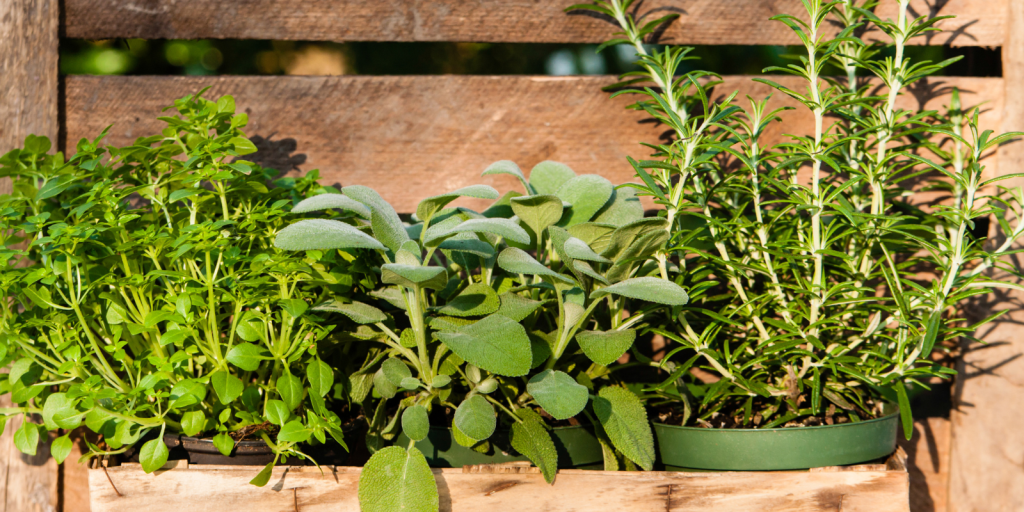
The herb garden always begins with “Scarborough Fair”—never mind that I rarely use sage, and the parsley inevitably becomes the breakfast, lunch, and dinner of swallowtail caterpillars by mid-June, and rosemary and thyme are fall herbs suitable for roasts and smoked cocktails, and my most-used summer herb—basil—doesn’t even make the cut. Without fail, I sit down to write my garden center shopping list, and the quartet rolls off the tip of my pen like a writing prompt for further herbal brainstorming. Never mind they’re not my Mouth Rushmore of herbs. Never mind they aren’t my John, Paul, George, and Ringo. It’s parsley, sage, rosemary, thyme… and then my fifth Beatle contenders begin to line up.
To start, the aforementioned basil. Essential for Caprese salad, pesto, and Margherita pizzas, but infinitely flexible as a quick topping to pasta dishes or to elevate a casual salad. Next, mint: mostly a requirement for juleps and desserts, but a frequent surprise inclusion in herby Mediterranean or Middle Eastern sauces. Controversially: cilantro, also known as coriander. Now, I am a fan, un-cursed as I am by the soap gene. It’s hard to get very far in the cuisines of Mexico, India, or various parts of East Asia without a generous handful of cilantro to finish things off. The downsides: you need so much of it, and it’s a floppy and anemic herb to grow, and somehow it’s the fist of anything to get aphids. Nonetheless. We’re giving it another go this year.
Now to the back-half. Every year I buy oregano. I never use it. I admit this is a disservice to oregano. The failing is entirely my own. I have also, in past years, bought oregano’s sweeter cousin, marjoram. I don’t know that I like marjoram, but I consider this also a personal failing—one to overcome through experimentation and persistent use.
The same can be said of dill. Russia nearly destroyed me for dill—dill in everything, and only dill in anything. My friend Max loves dill. He gushes about dill. (He is unaware he gushes about dill.) I kept quiet. I enjoyed the dill. Dill went through a rehabilitation process. A month ago, I developed a sudden and urgent craving for egg salad—a craving which could only be satisfied through the inclusion of dill. Dill made the herb garden list this year.
My own crusade? Tarragon. Oh god, glorious tarragon. Show me a recipe with tarragon and I’ll make it. I have a tarragon chicken recipe that consistently slaps. I made it for my brother’s children, and his picky three-year-old devoured it. I made it for my Aunt and Uncle, my cousin and his wife, their twins: I was told I could come back and cook any time. It’s the recipe I’ve made more consistently than perhaps any other—save my quiche. I bet I could make a really good quiche with tarragon in it.
Tarragon—quiche—eggs—chives. The thing is: you can’t compensate for a lack of chives by just putting onion in. I mean: similar properties, sure. You can make do. But following my dill-enabling egg salad craving, I grew desperate for deviled eggs—and for as fantastic as my spontaneous deviled eggs were, they lacked chives. I’d already put in my herb garden, sans chives. I found a new pot, and bought chives.
Finally: lavender. I’ll be honest, it’s not generally for me. I may not have the cilantro soap gene, but I have the culturally conditioned lavender—soap association. However, the Internet tells me lavender can help repel aphids and attract bees, so we’re giving it a go. I don’t object to lavender as a scent. I bet I could even make a nice simple syrup from it. Why not.
That was my herb garden for the year. I went to the garden center, decisively minded, bought the usual, and planted it. I bought herbs, and flowers, and various vegetables that the garden center assured me would thrive in pots in a patio context, and so I invested in three varieties each of tomatoes and peppers, and bought bush eggplant and bush beans and bush cucumber, and a squat yellow squash the shape and name of lemons. Done and dusted.
And then Memorial Day came, and Max-of-the-dill-obsession wanted to go to a different garden center, and look at different vegetables, and one of my deck neighbors had moved out, and the other showed no signs of using his own deck space, and so I commandeered a couple more pots and opened my heart to chives and a few more flowers and the general unexpected.
And here is the rub, the difficulty, the true challenge of herbs-as-garden-purchase: where do you stop?
It’s hard enough going to the garden center with “Scarborough Fair” in mind and telling yourself flat and not curly parsley, and English thyme, and yes surely if I had enough time to think about it, and if I could just make this choice once, I would settle on a variety of rosemary which would be my own unique cultivar of rosemary henceforth, be it “barbecue” rosemary, or tuscan blue, or creeping/trailing/ground cover rosemary—surely the differences cannot be so consequential. And surely the difference between purple and variegate thyme is one of aesthetics, despite what the handwritten placards tell me of pineapple sage and its sweet and acidic flavor. And for as much as I’ve told myself that I don’t need to revisit the thyme question, I’m haunted by a moment three years ago when a new friend swore by lemon thyme as a key purchase one summer for their own oft-revisited chicken dish, and perhaps my own preference for English thyme is because my purchases of French tarragon and Greek oregano and Italian parsley are driven more by a delight of international nomenclature than by the ideal properties of each specific herb, and that’s not even touching upon the caraway thyme which I only now just discovered while running a Google search to refresh my memory on the options I had seen at the garden center…
Still, we can draw some lines. The Scarborough Fair herb cultivars, as different as they may be, are relatively interchangeable.
Not so basil.
I planted Italian basil this year. I passed on Thai basil, which I expect I may regret. This is also not the same as holy basil, which is essential for pad kra pao. How much pad kra pao will I make this summer? Who knows. I’ve made it with Thai basil, whose sweet, anise-like scent places it squarely in the company of tarragon and caraway, but I know it’s not an ideal substitute. And yet, how many cultivars of basil can one patio garden support?
I refuse to consider mint. Peppermint, spearmint, chocolate mint—I’ve defaulted to the mint labeled “mojito mint” as the one most directly tied to its end use. Thank god there is only one cilantro, only one dill, only one chives. Probably this isn’t even true, but for now, I need it to be.
Because the trip to the new garden store has opened my eyes to novel categories of herb—ones I haven’t used, ones no one I know uses, and yet, ones which will have a hold on my mind from now till next spring when I can revisit my herb garden anew.
First: Summer savory. It’s like every hardy herb rolled into one. No wonder it became the default adjective for complex, meaty flavors. Also featured: lovage, sweet woodruff, and anise hyssop. Bruised and rolled between my fingers, the lovage smelled of pungent celery, the woodruff like grass, the hyssop—licorice. But above all, the rue: I live for new flavors. I remember the first time I ate a kiwi, the first time my mom made guacamole (without cilantro), my first mango, the first time my friends’ Mexican mom made guacamole (with cilantro), my first persimmon. Smelling rue was like opening a cedar chest. It smelled like my grandparents’ home. Like nostalgia.
Not all discoveries were pleasant. A crushed leaf of epazote smells of turpentine. Maybe my herb garden has a limit after all.
I’m often torn between the desire to buy the herbs I know I will use the most, keeping them on hand to spare myself trips to the grocery store, and rarer varieties that I won’t be able to easily find if I don’t grow them myself, but which I may only use once or twice in a given summer. My heart wants it all. But that’s the beauty of a garden. You don’t really have to make a single choice for all time. You don’t need a signature rosemary. You don’t need to make pad kra pao every summer. Some flavors will stay with you for life, and some will be with you for only a season. In the end, constraints will push you to discover new things. This herb garden that I planted is what I have for the year. It’s up to me to make the most of it.

 L. H. Lynch